Vishnu Vardhana
Pranav Srivilasan
When Ford deployed conveyor belts at its factories in 1913, the continuous assembly line was born, and has pretty much dominated mass manufacturing ever since. The linear transition of a part from one specialised station to the next on a fixed line is unmatched for high volume production of a specific product.
But we came to the realisation that, for us and any other startup ramping up multiple products in multiple categories, the fixed assembly line has a big drawback: It locks us into a certain capacity for each product. (It’s also a very capex-heavy approach up front)
Today, alongside product innovation, companies around the world are thinking of ways to innovate on the manufacturing process itself. From Tesla’s “unboxed” process to Ford’s new “assembly tree” to fully automated “dark” factories.
For us, the ability to adapt our production mix in a single facility, with a tight team, trumps everything else.
That pushed us to rethink and to imagine a flexible manufacturing framework around three key concepts:
AGVs over conveyor belts
Intelligence in equipment
Digital systems and traceability
It’s a blueprint we think makes sense for anyone scaling up from 1 to 100 with a product mix that involves a lot of variants and constant change.
AGVs over conveyor belts
The AGV is not a new concept. An “automated guided vehicle”, basically a wheeled cart-like robot that carries parts, materials, or packages.
Why they enter the picture is because we actually want to break free of the fixed assembly line.
For any product, the manufacturing process is a series of steps in a specific order.
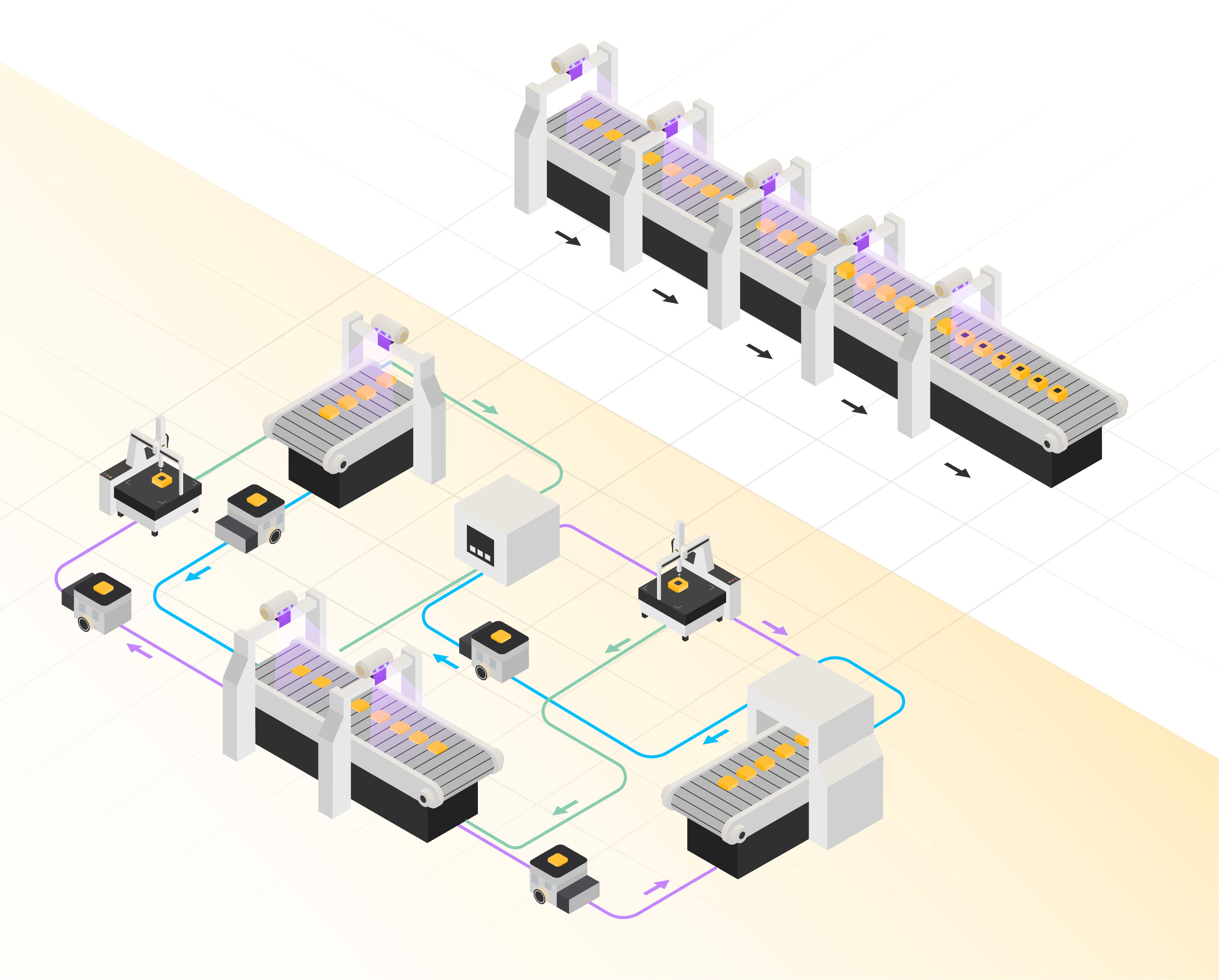
The conventional setup bakes that process into the assembly line. Every station along the conveyor belt has a human operator or robot doing a single task, each task is a step in the process for a specific product.
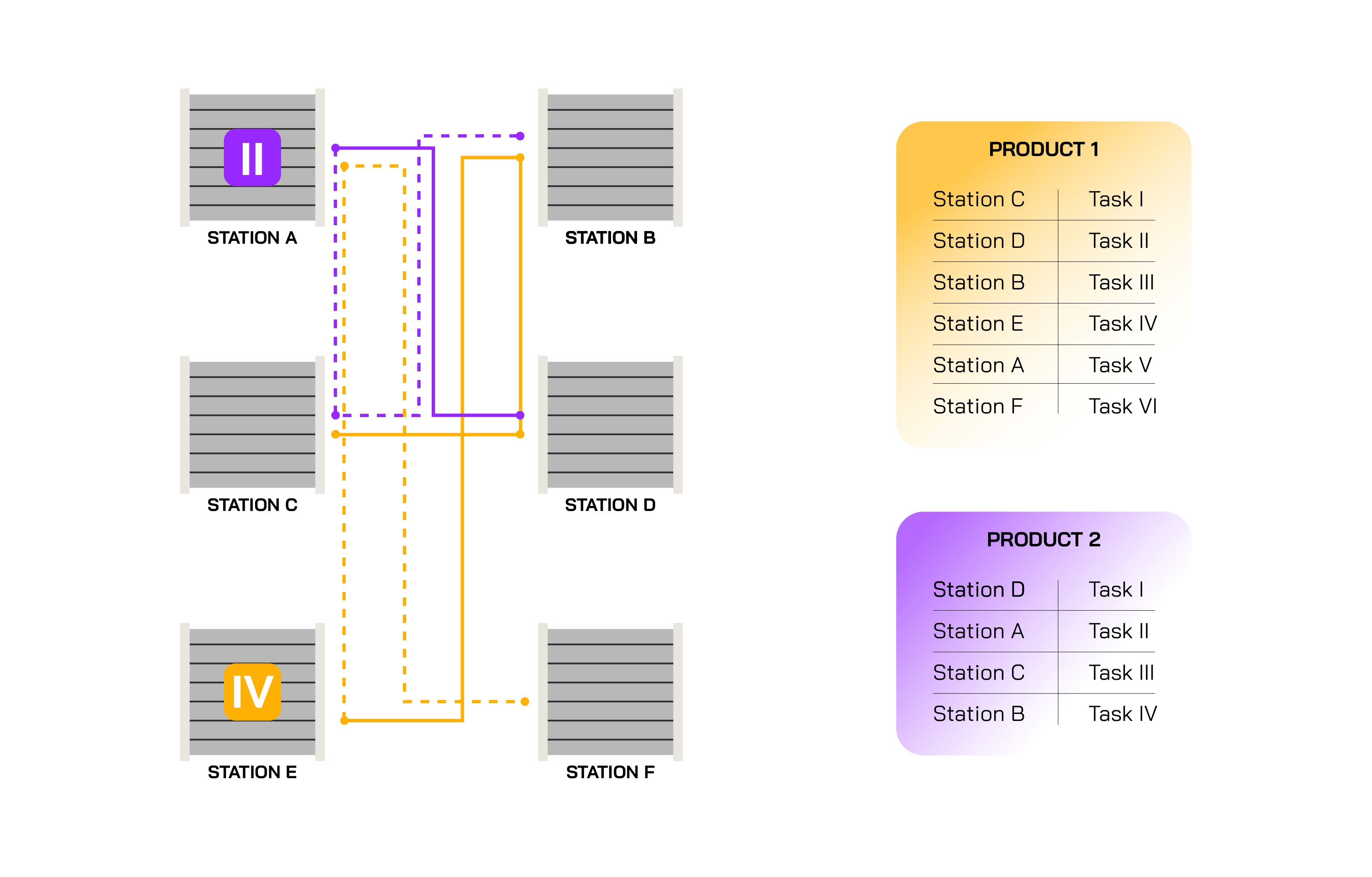
If you want to produce a different product with a different process of steps, you can’t. e.g. it’s not possible to go from Station A to Station C, then back to Station B, and skip Station D.
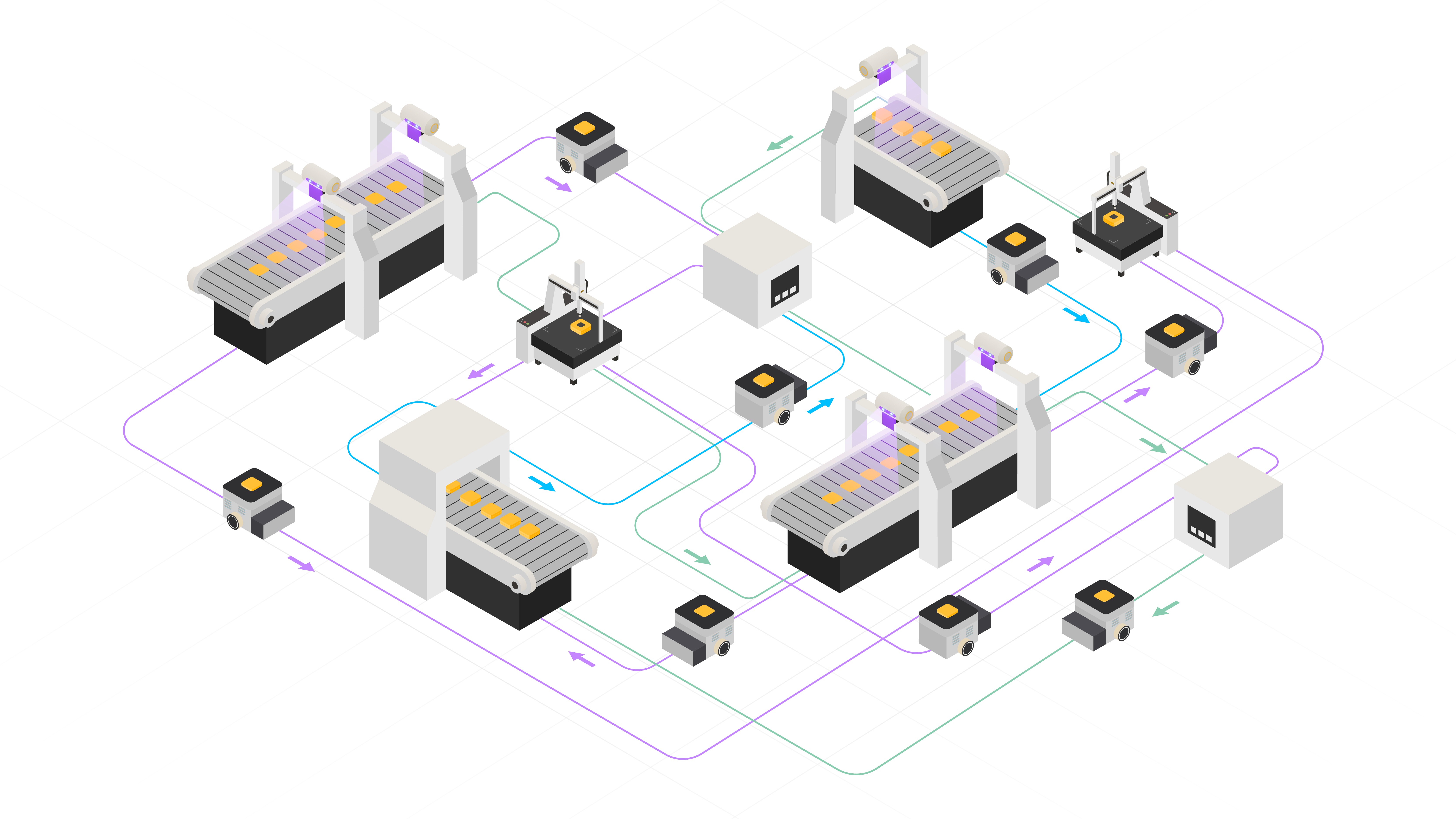
Flexible manufacturing needs you to break up the entire construct and spread stations out in the factory. Dump the conveyor belt and have AGVs that can be programmed to carry parts to the right station for the right product.
Each product in the mix has a different sequence of steps in the manufacturing process. A robot carrying parts for Product A gets routed to the right sequence of stations for that product. For Product B a different sequence, a different route.
With the same workforce, equipment, and factory floor, this lets us dynamically produce everything from an autorickshaw pack to a bus battery.
Intelligence in equipment
To enable that flexibility, you need to redo your processes and systems (more on that shortly), but you also need to invest in production equipment that is also intelligent.
“Intelligence” is a word that gets thrown around a little loosely, but what we mean specifically is machines that can automatically adjust to a range of parts in production.
For example, while building different battery packs, different products might use varying cells. The height or width of one pack’s cells might be very different from another pack’s cells.
If you want to use the same workstations and machinery to build both products, your automated equipment needs to be able to make adjustments on the fly. If it’s, say, a welding machine, instead of the operator having to manually enter exact coordinates, it should be able to detect the component, measure the dimension, and weld at the right location (based on a broader set of programed parameters).
By investing in capabilities for production equipment upfront, you unlock the possibility of running the factory at scale with a flexible process.
Of course, to manage that dynamic allocation and run the flexible manufacturing line at peak efficiency, we need to revisit production management software and systems.
Digital systems and traceability
The control center for manufacturing operations is the MES, or Manufacturing Execution System:
A single hub for all information on materials and parts in production, with real-time status on work underway.
Controls for every product, from process flows to quality checks (automated or manual) to safety requirements to scheduling.
Process is everything, and a well-structured MES has always been important in manufacturing. But with a move to a flexible manufacturing framework, process flows are not limited to a single assembly line.
The same worker at the same station might effectively work on two completely different products, so your processes, documentation, and controls need to be even clearer and stronger. Which also means you need to retool your digital systems (i.e. the MES) to match.
Process flows for each product will have to route parts between stations, while production planning needs to take into account the overlap (the same station might be used for multiple products, so you manage routing and scheduling accordingly)
To make this work, you also need to be able to trace parts and work in real time. Digital stamps and detailed information on each component, plus tracking and monitoring at each station. The amount of detail you need to capture will vary from component to component:
For high-value, critical components like cells, every single one will have an ID and digital stamp.
At the other end of the scale, e.g. for plastics, you might only have a batch number.
It all comes together in a system that has, at any given point in time, information on materials, components, job status, and timelines on the shop floor. That provides the foundation to actually make flexible manufacturing work.
As advanced hardware companies grow across the country, we have an opportunity to think about smarter, more nimble ways of approaching manufacturing. There’s no one-size-fits-all solution, which is kind of the point.