Arun Vinayak
Pranav Srivilasan
Charging anxiety, not range anxiety, is the biggest hurdle to EV adoption.
A 15-minute rapid charge plus longer battery life, paired with a great charging network, kills charging anxiety. That’s been our approach, and that is what will unlock the next phase of EV adoption.
But another solution targeting the same problem, envisioned years ago when “fast” charging meant hours, not minutes, is battery swapping. That is, design EVs with removable battery packs and have public stations filled with fully charged batteries that can quickly be exchanged.
We often get asked why we didn’t just do something like that, instead of building a completely new energy stack.
Short answer: We see better, faster charging and battery tech as a platform for the future of EVs.
This isn’t to say that battery swapping doesn’t have a place. It’s a solution that has worked well in use cases like micro-mobility (e.g., small rented two-wheelers for gig work). And it will continue to work for those niches, but it comes with a range of trade-offs that don’t make sense for most EVs, whether for commercial or personal use.
When swap gets stuck
The fundamental drawback of battery swapping is that it doesn’t fully solve the charging time problem.
In ideal conditions, a driver can come to a swap station and replace the vehicle’s battery or batteries in a few minutes. But the drained batteries put into the station still need to be charged before they can be used again, and that charging process can easily take a couple of hours.
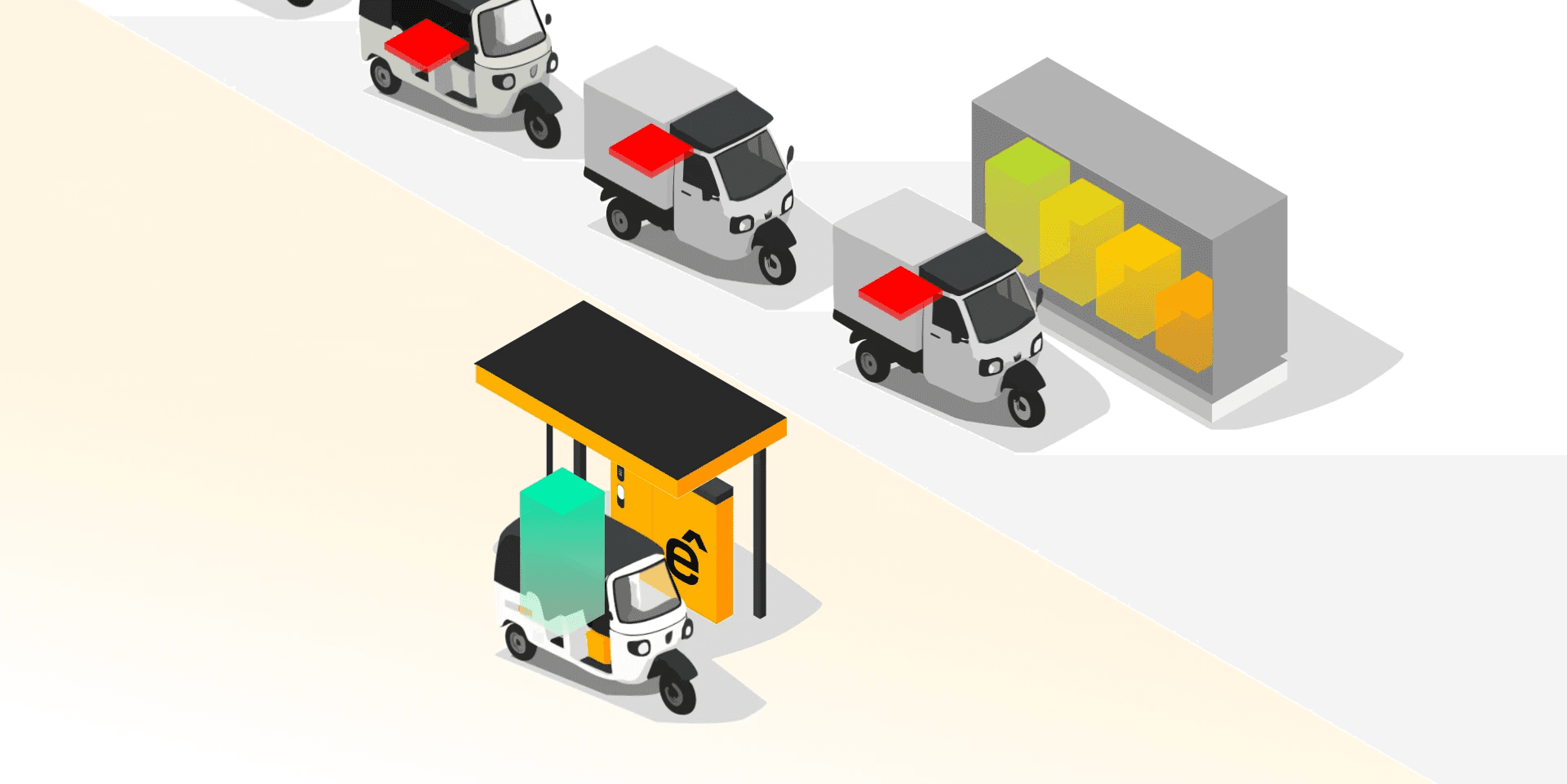
So, while a swap station lets drivers get fully charged batteries in 3-4 minutes, once all the packs have been swapped out, the refuelling time goes from minutes to hours. That looks something like this:
Battery swapping does provide a very quick refuelling/recharging option for EVs, right up to the point that every pack has been swapped out. Any time more than 3-4 vehicles turn up in the span of an hour, charge times shoot up.
In the end, swapping is an operational band-aid for slow-charging batteries.
Because it doesn’t solve the fundamental issue of actually charging batteries faster, queueing can only be (partially) solved by maintaining a bank of extra batteries in the system. But that leads us to the next big drawback: cost.
The float burden
In the swap approach, vehicle owners don’t own the batteries, the network operator does. And to keep energy flowing, the network needs to have more batteries than vehicles. One battery to go inside every vehicle and then a bunch of extra batteries waiting at swap stations.
This extra capacity, or “float”, obviously adds to the cost of the network, which means swap operators need to manage a fine balance.
If you have too few float batteries in your network, they get used up quickly and lots of drivers have to wait a long time for batteries to recharge at the swap stations. But to have enough battery packs that you can ensure every driver who comes immediately gets a fresh pack anytime, you have to invest an enormous amount of capital in the network.
So, usually, the operator might have 3 battery packs for every 2 vehicles in three-wheelers, or 1.5x as many packs as vehicles. For two-wheelers, it might be closer to 2x, and so on.
One outcome of this is that swapping costs drivers much more per unit of energy than just charging a normal fixed-battery EV. While the upfront cost of the vehicle comes down, since the driver isn’t buying a battery, monthly swap costs are way higher than charging costs.
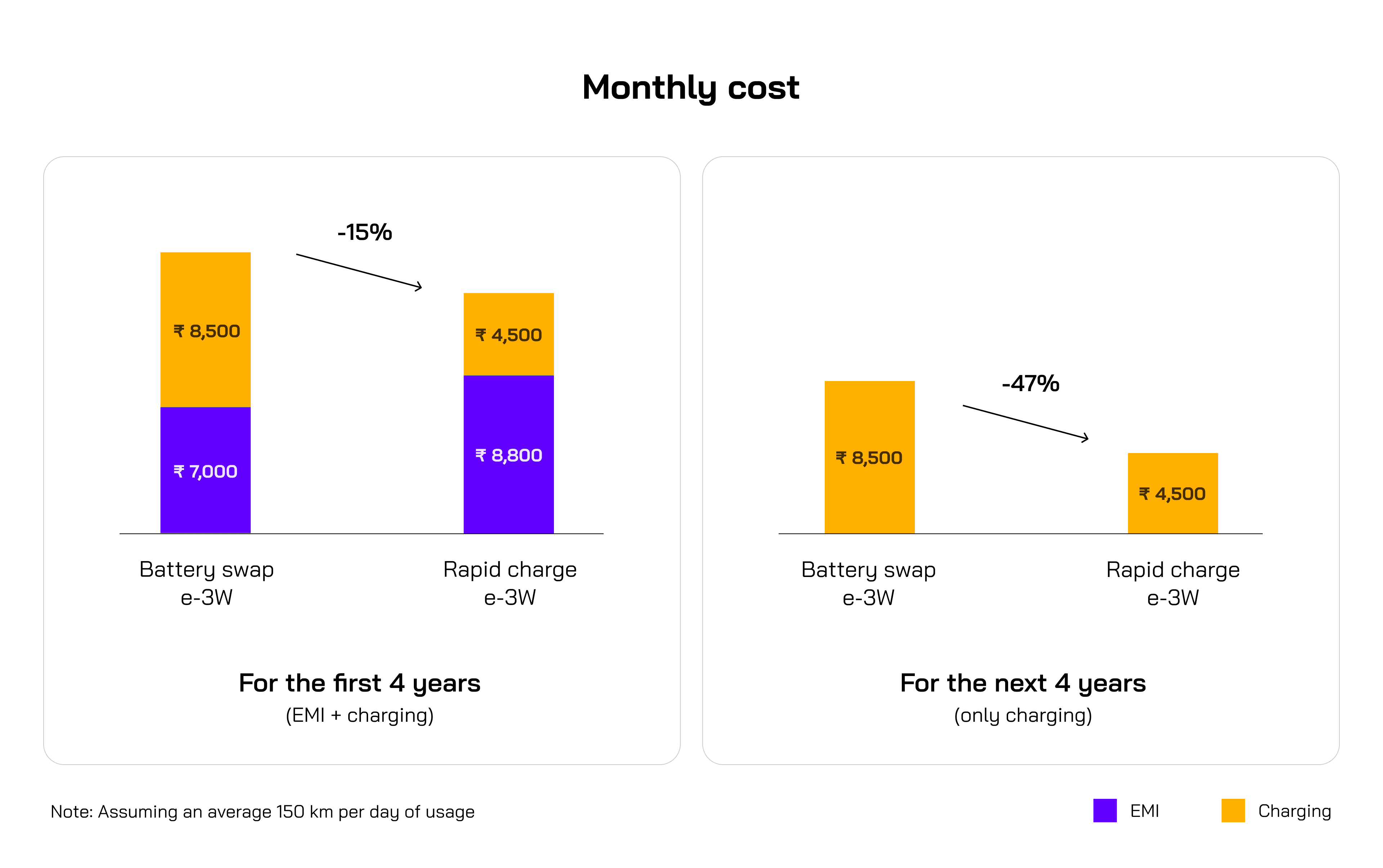
For the driver, rapid charging translates into 30-45% lower monthly costs.
This is because the cost of charging at a swap station includes both the electricity and fees to cover the cost of the battery. Whatever the driver saves by getting a lower EMI on the vehicle, they lose completely by spending on battery swapping every month. And they keep having to pay that higher energy cost even after their vehicle EMI is fully paid off.
At the end of the day, for most commercial vehicle drivers, rapid charging is cheaper than battery swapping.
And that’s before we get to the technical battery compromises of managing swappable packs.
Packaging efficiency, dead kilometres, cell balancing
If you want a user-removable battery in an EV, weight and packaging are concerns.
For example, to make battery swapping possible for a three-wheeler, you need to split the battery into multiple independent packs. A three-wheeler with 4.5 kWh of total battery capacity might have three 1.5 kWh packs, so that each one is not too heavy for the driver to pull out and replace.
This adds to the cost and complexity of the system:
Each pack obviously needs its own mechanical casing, as well as passive thermal management.
The casings and external connectors need to be engineered for additional wear and tear from being removed and reinserted repeatedly.
Each pack also needs its own independent battery management system (BMS).
The vehicle needs to balance cell charge levels across multiple individual batteries.
Net result: Apart from compromised performance and life, swappable batteries need 2x the packaging for the same capacity
That’s a significant cost and space disadvantage. Fixed batteries occupying the same space within the vehicle can pack in much more battery capacity (almost 2x). For example, three-wheelers with fixed batteries have 10-12 kWh capacities, while battery-swap three-wheelers are usually limited to 4.5-6 kWh capacities.
For a battery-swapping vehicle, that means less range in a single charge and 2x the number of visits to swap stations. Drivers hate that, because they spend extra time and dead kilometres driving to a station that they don’t get paid for.
Scaling across vehicle classes
The next problem with battery swapping is what happens when trying to scale it up across heavier vehicle classes.
For categories like cars, buses, and trucks, the battery packs get heavy enough that it’s impossible for the driver to physically carry them. The battery for an EV bus can weigh 2-3 metric tons. So, you need automated swap stations, with mechanised systems that swap packs in and out of the car or truck.
This adds even more upfront cost to the network, which translates into higher prices for consumers.
The bigger the vehicle, the more the capex requirements for the swapping network.
With fixed batteries and rapid charging, you just need to plug in a connector, even for megawatt-scale chargers that can rapid-charge buses in 15 minutes. It’s way easier to move electrons quickly than to move tonnes of batteries in and out of vehicles every day.
Interoperability
Another challenge for the driver or owner of a battery-swapping vehicle is that they get stuck with just one energy provider.
This might seem obvious, but it’s a big limitation. There’s no interoperability between battery packs made by different battery swapping companies. So someone who buys a vehicle with one company’s battery packs is forced to only use that company’s swapping stations.
They can’t even charge at home or from a normal charging station, since battery-swapping vehicles with multiple packs are usually not designed to charge directly from a plug.
On the other hand, a rapid-charging vehicle can have multiple ports.
Even if rapid charging requires a custom port, the vehicle manufacturer can add a standard CCS2, GB/T, or other port. This can be used for home charging, but also for charging at other public stations. A swappable vehicle doesn’t get that option at all.
Finally, swaps also have significant downsides for the vehicle manufacturer.
OEMs don’t want to be commoditised
Every OEM has different product roadmaps, every vehicle has a different design, targeting different types of customers.
When you standardise the entire battery and a large part of where and how it will be put in/removed from the vehicles, you effectively restrict vehicle design. Capacity, range, power levels, chassis architecture, etc., become constrained. Little room for innovation. Engineers often end up having to compromise in terms of battery capacity and vehicle dynamics.
A fixed battery pack can be designed specifically to fit a vehicle. This gives the OEM the flexibility to think about the best possible vehicle design and incorporate the battery accordingly. A vehicle can even have a structural battery pack, saving space and weight.
Battery swapping effectively commoditises OEMs and vehicle design.
And OEMs know this, which is why we have seen so little adoption of battery swapping.
This is probably why the only examples of battery swapping at scale are vertically integrated companies like Nio in China and Gogoro in Taiwan, where the same company is an OEM as well as the battery provider and swapping network operator. That allows them complete control over vehicle and battery design, plus the relationship with the end-user.
That fully integrated approach is hard to scale and does not make sense for most OEMs, which is evident from the fact that the vast majority of EVs in China—the biggest EV market in the world—use fixed batteries.
Stuck on the innovation curve
As battery innovation happens over time, OEMs and network operators are left with a pool of older batteries and stations. Upgrading those becomes another cost and operational headache.
Nio in China is again a good example. It has developed multiple generations of battery packs over the years, but newer vehicle models can’t use older generation swappable packs, and older generation stations don’t have the capacity to mix and match packs of different generations.
A new vehicle ends up unable to use most of the existing network.
Again, for some use cases, these compromises might be worth it. But for the majority of OEMs and their customers, it probably isn’t.
With fixed batteries, every year, new products with updated energy technology can be launched and compatible with the same connectors and charging stations. New cell chemistries, new pack architectures, new BMS designs, no problem.
If we look at how battery-powered devices like phones and laptops have evolved over the years, all of them have converged on fixed batteries that aren’t designed to be user-removable (of course, they can be dismantled by a technician). The reasons: Tighter integration, weight and space savings, better protection, less wear and tear.
The same logic applies to EVs.
Better tech is the real unlock
One way to solve some of battery-swapping’s disadvantages would be if the swap station could rapid-charge the drained batteries in 15-20 minutes. Then the network can serve more vehicles without adding more float batteries. At that point, though, one might as well set up a rapid-charging station instead and drop the swapping idea entirely.
Rapid charging ultimately solves the charge time problem in a technology-first way.
On the whole, we would still say that battery swapping can work for some applications and niches. There’s never going to be one technology or provider or network that will cater to every user’s needs. Different uses will need different battery and charging ecosystems.
But for the majority of EVs, rapid charging is the clear way forward.